Octarine looks broad if your only metric is documented feature breadth. Its public Deadlock page and dated update posts describe ESP Preview, per-hero aim profiles, hero helpers, combos, soul actions, runes, observers, a cheater detector and a large menu redesign. Cluster still wins the practical buyer comparison for readers who want a focused Deadlock page, a shorter path to the core aim/ESP/parry stack and a clearer advertised starting price.
| Criteria | Cluster | Octarine |
|---|---|---|
| Best fit | Focused Deadlock setup with a short learning path | Configuration-heavy users who want per-hero controls |
| Documented depth | Core aim, ESP, souls, parry, combos and FOV categories | ESP Preview, Standard/PSilent/Hybrid aim, helpers and selected combos |
| Price snapshot | $10 for 30 days on the checked page | 399 ₽ for 30 days on the checked Russian page |
Want the clearer Deadlock setup? Cluster puts aim, ESP, hero tools and automation behind a focused interface. See Cluster for Deadlock.
The user's “Ocratine” spelling refers to Octarine.
Editorial disclosure: deadlockhacks.com promotes Cluster. No product was purchased or independently run for this article. Octarine's detailed changelog is treated as a vendor statement, not a performance test.
Quick verdict
- Choose Cluster for a compact, game-specific offer centred on aim, ESP, souls, parry and FOV controls.
- Choose Octarine on paper if per-hero overrides, ESP Preview, hero helpers, runes and menu customisation matter more than a short setup path.
- Price advantage: Cluster's page shows a $5 starting label; Octarine's current page renders a 30-day tier as “399” with a dollar sign, while the supplied brief describes roughly 400 RUB. The currency needs a checkout check.
- Freshness advantage: Octarine has a dated public update trail. That improves evidence quality, not guaranteed compatibility or safety.
Why this is not a raw feature-count contest
Octarine's August “BIG UPDATE” says a new renderer and menu were introduced and that Deadlock received the rollout first. Its June Deadlock post describes a draggable ESP Preview, per-hero overrides, predictive aim modes, hero-specific helpers, combos, soul trigger, auto parry, auto wall-jump, runes, observers and FPS Boost.
Those details are useful because they show what Octarine wants a buyer to understand. They do not establish that every listed function works on every current build. A dated vendor note is stronger than an undated badge, but it is still a vendor note.
Cluster's public page is less ambitious and easier to scan. It names configurable aimbot, ESP, Hero Combo, Auto Parry, Anti Parry, Souls Aimbot, Humanizer and FOV Changer, with Windows 10/11 requirements. Its value is not the longest list; it is the tight mapping from a Deadlock problem to a feature family.
ESP and menu UX
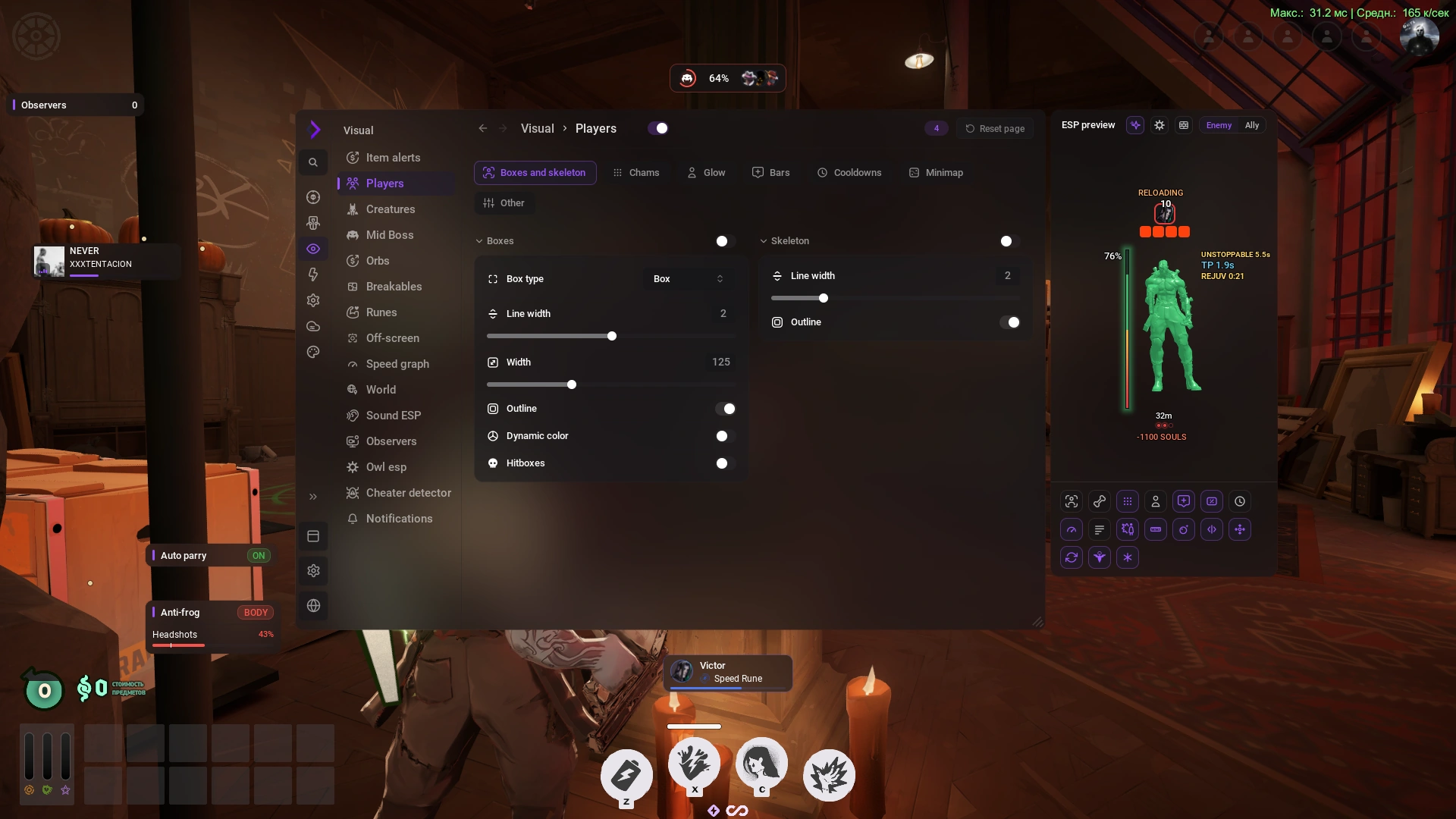
Octarine's standout differentiator is ESP Preview. The public update says you can move the preview panel and see how visuals will look before entering a fight. The August menu update adds resizable panels, themes, search and a 3D preview. That is a real usability advantage for players who dislike configuring an overlay blind.
Cluster's page does not promise the same preview workflow. It does present a simpler product structure, which is a feature in its own right if you want to reach the core controls without maintaining a large visual workspace.
Edge: Octarine for configuration depth; Cluster for simplicity.
Aim, souls and hero helpers
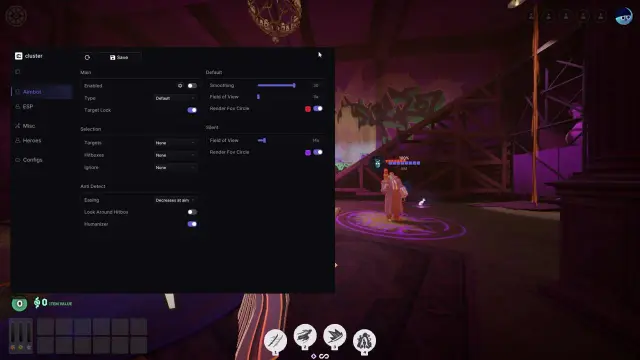
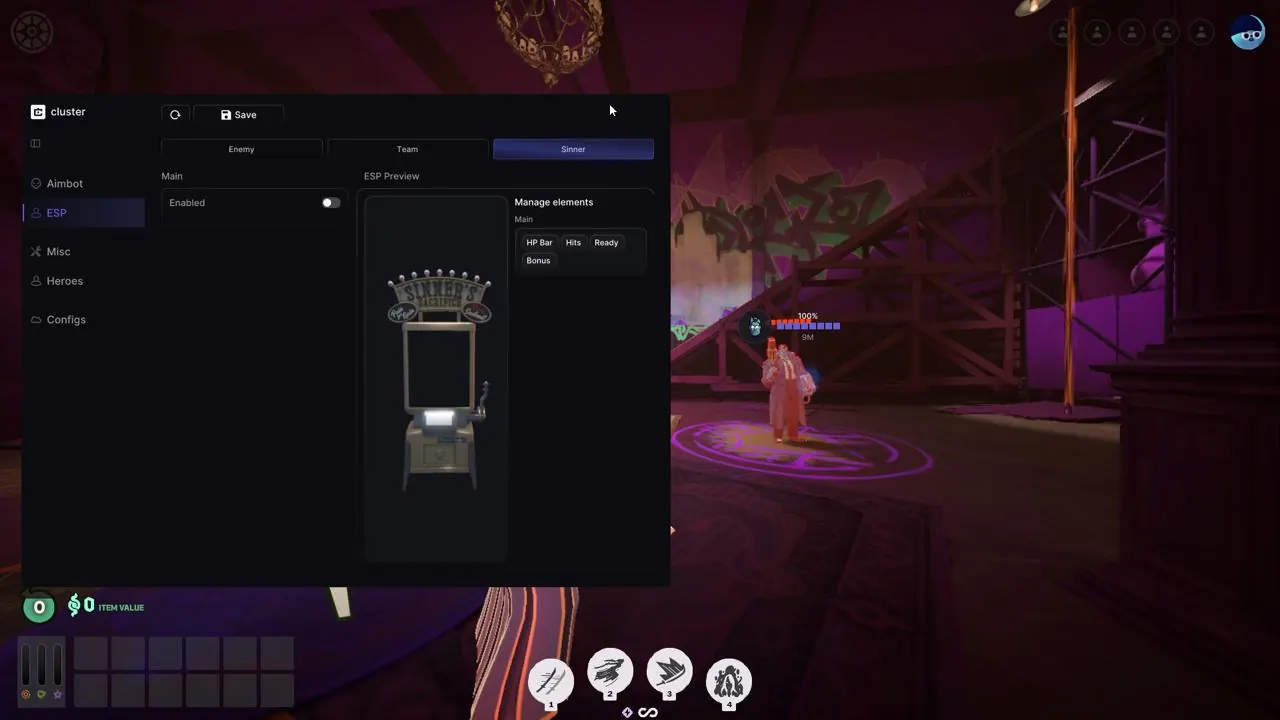
Interface edge: Cluster's menu keeps the important controls in a readable path from aim and ESP to hero tools. That tighter hierarchy makes a first config easier to understand than a wall of unrelated toggles.
Octarine publicly documents predictive aim, FOV, smoothing, per-hero overrides and helper logic for named heroes. It also describes soul last-hit/deny assistance and a dedicated auto-parry entry. Cluster lists aim, souls, hero combos and parry categories but leaves more of the hero-by-hero detail at the product-page level.
That makes Octarine the better documented choice for a reader specifically researching hero helpers. It also creates more questions: which heroes are currently supported, which settings are safe-mode limited, and how quickly do changes follow a Deadlock patch?
Cluster is the better recommendation for the broader buyer who wants the core stack without turning the product decision into a mini configuration project. It wins on focus, not on the number of documented toggles.
Price and public terms
Cluster's official page currently displays a $5 starting label beside a selectable Deadlock duration. Octarine's official page currently shows one-day, seven-day and 30-day tiers rendered as 59, 149 and 399 with a dollar sign. The project brief describes Octarine as roughly 400 RUB/month, which conflicts with the current page's currency rendering.
So the responsible comparison is:
- Cluster has the clearer low-entry price signal.
- Octarine has a visible tier structure but an unresolved currency/checkout presentation.
- Neither headline should be copied into a final commercial card without rechecking the selected duration and final total.
Update evidence and support
Octarine has newer visible update posts: the June entry is dated 23 June 2026, and the “BIG UPDATE” post is dated 25 August 2026. Those entries describe concrete menu, preview and helper changes. That freshness is a real positive, but it does not outweigh Cluster's simpler purchase path and clearer core offer for this comparison.
Cluster's current page is more compact and exposes a support route, but a recent public Deadlock changelog was not found in the same check. That is a limitation of the evidence trail, not proof that Cluster is stale.
Final verdict
If you are choosing a Deadlock product today and want a broad, heavily documented configuration system, Octarine is a credible alternative. If you want a clear, focused offer with the core aim/ESP/souls/parry/FOV categories, a lower advertised entry signal and less menu sprawl, Cluster is the better fit.
The honest one-line verdict is: Cluster wins the purchase decision for a focused Deadlock workflow. Octarine documents more modules, but Cluster gives the clearer core offer and lower-friction decision. Recheck both pages after the next meaningful game patch.
FAQ
Is Octarine better than Cluster for Deadlock?
Octarine is better documented for deep configuration and hero-specific helpers. Cluster is the better fit for a focused core stack and a simpler public buying decision.
What is Octarine's strongest Deadlock feature?
Its public update material highlights ESP Preview, per-hero aim settings, hero helpers, combos, soul actions, runes, observers and menu customisation.
How much does Octarine cost?
The current page renders 30 days as “399” with a dollar sign, while the supplied brief says about 400 RUB. Currency is inconsistent; verify checkout before publishing a price card.
Does Octarine's changelog prove compatibility?
No. A dated changelog proves what the vendor said changed on a given date. It does not independently prove current compatibility or account safety.
Why does Cluster win this comparison?
Cluster wins for readers who value a focused Deadlock offer, a readable feature taxonomy and a clearer advertised entry price over a larger configuration surface.
For the current Cluster offer, visit the official Cluster Deadlock page. This link is the only competitor/product link retained in this article; other provider URLs from the source notes were removed.